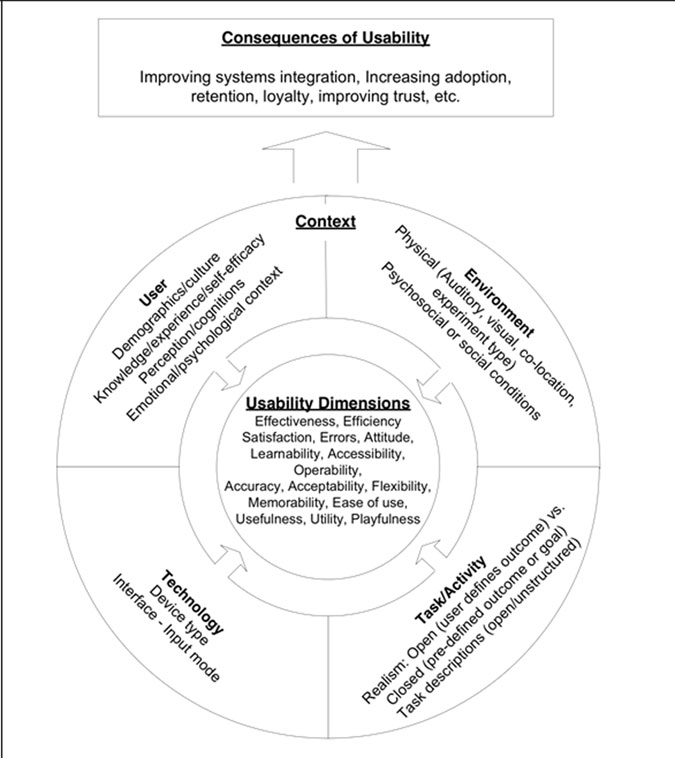
Usability framework for mobile designs
Constantinos Coursaris and Dan Kim argue that “usability is a more important issue for mobile technology than for other areas, because many mobile applications remain difficult to use, lack flexibility, and lack robustness” (A Meta-Analytical Review of Empirical Mobile Usability Studies, Journal of Usability Studies, May 2011). They highlight challenges such as small screens and non-traditional input methods, among others.
To help improve the focus on mobile devices, they extended discussions and frameworks proposed by Han et al. (2001) and Kwahk and Han (2002) to create a contextual usability framework for mobile computing environments:
The concept of “Context” is not new to any of us in the field, but two elements of the framework deserve special attention.
First, they explicitly used “Technology,” rather than “product” or “device” because mobile devices fit within a larger ecosystem of technology. The wireless or data network impacts the user experience with the device and its applications. The application iTunes on the user’s laptop influences their interaction with their iPhone or iPad.
Secondly, “Environment” is a critical factor. In their qualitative review of 100 empirical mobile usability studies, only 11% of studies explored factors as they relate to the environment. Coursaris and Kim see a huge opportunity to study environmental characteristics:
“For example, little is known about the impact of collocation (i.e., a mobile user being in physical proximity to other individuals) on the use of a mobile device (e.g., which types of applications are more likely to be used when alone vs. collocated with familiar or unfamiliar individuals).”
This is fascinating given that a primary purpose of mobile devices is to be used in a non-sedentary environment that involves interacting with (or at least being in the proximity of) other individuals. Studying real users in the real world (conducting real tasks) can be daunting, which is likely why many researchers fall back on controlling as many variables as possible. Conducting research in a lab has many benefits, not least of which is the ability to easily collect the actual measures of the “Usability Dimensions.”
Our challenge then, as researchers, is to determine how we can extend our research to these more realistic situations, whether those are “mocked up” in a complex lab setting or using some other research technique.
Some of the research that Coursaris and Kim analyzed included lab settings with environmental conditions, such as participants walking on treadmills, walking along paths and obstacle courses, and high vs. low light conditions. Other approaches include prototype interfaces where user behavior can be tracked while they are “in the field.” Self-report or diaries from users in the real world is another approach.