Reader comments
Jyoti
Xebia
I agree with Parallel Prototyping we can encourage designer to overcome his own lacking area and help to build his confident.

Parallel prototyping leads to better design results, more divergence, and increased self-efficacy. Dow, S. P., Glassco, A., Kass, J., Schwarz, M., Schwartz, D. L., and Klemmer, S. R. (2010.) ACM Transactions on Computer-Human Interaction, Vol. 17, No. 4, Article 18, 24 pages.
Ten years ago in an HFI UI Design Newsletter on Parallel Design, we reviewed research that showed that user interface designers should try to consider as many alternative design ideas as possible before selecting the best with which to begin the iterative process.
With the Parallel Design technique, several different people create an initial design from the same set of requirements. Each person works independently and when finished shares the concepts with the group to improve the ultimate design.
But what if we also wanted to improve the quality of designs produced by the same person? This is where Parallel Prototyping comes in.
Iterative design can help people improve ideas but it also can lead to fixation in which a designer continuously refines one option without considering others. How can we overcome iterative design that is too narrowly focused?
In a recent experiment, independent novice designers were asked to create graphic Web advertisements. All participants created five prototype ads and then a final ad. They all received a critique on each prototype. Participants worked independently and were given equal time to create each prototype and read each critique.
What varied was the structure of the process as shown in Figure 1:
First, it was expected that Parallel Prototyping might produce better designs, because the designer can compare among design critiques rather than focusing on just one. This was found to be true. Ads created in the Parallel condition significantly outperformed those from the Serial condition based on both click-through data and expert ratings. The use of web metrics to quantify the results was said to be a new addition to this type of research.
Second, Parallel Prototyping was expected to encourage exploration because each person had to consider design alternatives from the beginning. Parallel prototypes were in fact found to be more diverse as rated by experts.
Third, it was expected that Parallel Prototyping would shift the emphasis of the critique from the person and his or her one design to the multiple design concepts themselves. Therefore each designer would feel less criticized personally, and be able to focus on constructive design solutions. Parallel participants reported a larger increase in task-specific self-confidence.
So encouraging a designer to develop multiple concepts first could be a way to improve the effectiveness and diversity of the ultimate design as well as helping team members feel more confident.
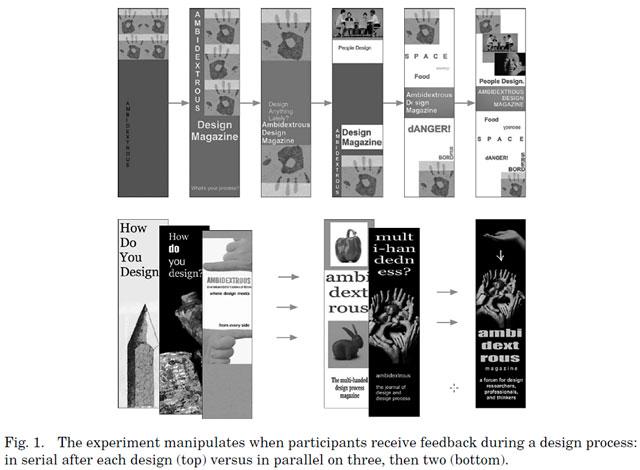
Dow, S. P., Glassco, A., Kass, J., Schwarz, M., Schwartz, D. L., and Klemmer, S. R. (2010.) Parallel prototyping leads to better design results, more divergence, and increased self-efficacy. ACM Transactions on Computer-Human Interaction, Vol. 17, No. 4, Article 18, 24 pages.

Thanks Cathy for revisiting this topic of parallel design. I suspect that it is most valuable in more ‘creative’ work. In many cases there is a clear single engineering solution for the design of interface containers.
Looking at the designs, I think that education in the basics of persuasion methods would help more than any amount of parallel design and iteration.
That said, clearly parallel design is a solid best practice and perhaps we should actually go ahead and use it more routinely!
I agree with Parallel Prototyping we can encourage designer to overcome his own lacking area and help to build his confident.
Sign up to get our Newsletter delivered straight to your inbox