
- About us
- Contact us: +1.641.472.4480, hfi@humanfactors.com
Cool stuff and UX resources



"Flow" – the iPhone (and Web) Experience that Sells
Are you experienced?
Jimi Hendrix had no lock on what sells when it comes to selling "experience that attracts customers".
Look at the top downloads for iPhone apps and you see someone's personal retirement funds collecting on a daily basis from the profits on "experience".
By the way, this discussion of iPhone apps can equally apply to your website. How DO we make a website experience enjoyable? What qualities make surfing your site more fun than average? Let's talk about iPhone apps first.
The real question is: What separates the experience offered by the high-roller apps from the also-ran apps? Yes, it might just be word of mouth: your buddy told you to check out Mini Golf 99 Holes Theme Park or iHandy Level or Tap Tap Revenge 2 or Lose It for watching your calories.
On the other hand, marketing research firm Pinch Media tells us that for free and paid applications, only about 20-30 percent of users (meaning you) come back to an app after the first day. Only 5 percent use the app after 30 days.
Word-of-mouth does bring app users to the table. But it doesn't keep them there. Seventy to eighty percent of app buyers drop the ball after just one day. What's going on?

Getting into the "flow" experience
User-interaction research tells us what people want in computer interaction. Research on the "flow" experience builds on knowledge of "peak experiences".
You've probably heard sports figures report their peak experiences of "being in the zone". Well, for regular folks like you and me, the equivalent experience is "flow".
Let's see what "flow" feels like (are you experienced?). Remember the last iPhone app you tried out. Was that Ocarina or Around Me, or Wikipanion or Amazon?
I'll talk about Amazon because that's where I get the experience of flow when shopping for books.
From the originator of the flow concept, Mihaly Csikszentmihalyi: flow is a "holistic sensation that people feel when they act with total involvement." (Look up Mihaly on iPhone's Wikipanion!)
Well, that's a mouthful. We just read (again): "acting with total involvement". When did you last have that experience?
Well, maybe YOU haven't had that holistic sensation yet with Amazon, but what about Tetris or Tap Tap Revenge 2?
Absorbed in activity
Here's another clue to the flow state: people "become absorbed in their activity".
Imagine you are running to catch a 40 yard pass for the Rose Bowl. Sports figures report these experiences when they're "in the zone". Regular people have similar reports when they're "in the flow". They experience...
- narrowing of the focus of activity
- filtering out of irrelevant perceptions and thoughts
- loss of self-consciousness
- responsiveness to clear goals
- a sense of control over the environment
Does this sound like your experience with the iPhone in general? Well, that might be an exaggeration. But for a given application – whether iPhone or the Web, you can try to provide the experience of flow for your customers.
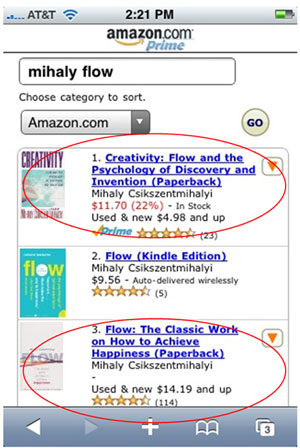
Figure 1. Prime 2-day delivery is "free" after signing up for the program. The used book costs $4,00 extra for shipping. So, do the math. Add $4.00 to the used book price of 4.98 = almost $9. But it takes a 7-10 days to get the used book. The new book with Prime costs $11.70, only $2.70 more. I'm happy to pay the extra $2.70 and get the book in 2 days instead of 7-10. Just evaluating all this plus the option of rapid fulfillment puts me in the "flow" experience. Even better, sometimes I'll click on the author's name to see the list of books in order to find a cheaper used book. I look for instances of the same book title but with a different price! It happens!
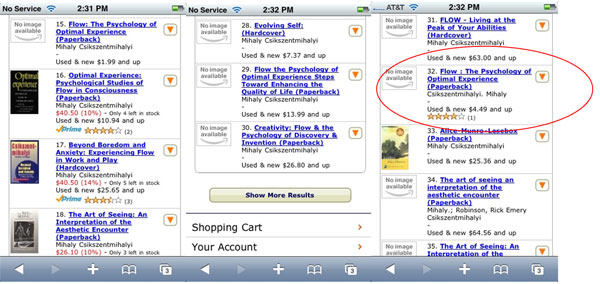
Figure 2. Note that the same title "Flow: The Psychology of Optimal Experience" shows up at least twice on the search results list. At this point, my instincts for "shopping excellence" overtake me, and I compare the used book prices. $1.99 versus $4.49 makes the choice easy. If I want the used book, I'll take number 15 – the $1.99 version. And I had fun searching the lists for the best deal.
Amazing Amazon
I'll report what happens to me with Amazon when shopping for books.
First, I find it easy to do the search. I put in a topic, author's name, or a portion of the title. Not hard to do, and it gives me a list with the best matches at the top. No "flow" yet.
But, when I start hunting for that special book I really really want, (I'm a book hound) I can narrow my focus of activity. (Remember "narrow focus of activity" for flow?)
I read down the search results list rapidly reviewing and evaluating titles, authors, and best of all, the pricing for new and used books. I check out the all-important Amazon discount. That gives me a sense of control, too. (Remember "sense of control" for flow?)
Even better, since I'm a nut for fast delivery, I already have signed up for 2-day Prime service. Therefore Amazon's "Prime" logo becomes another clue to fulfilling my need for speedy retail response.
My focus rapidly narrows to "Prime" but also negotiates the cost difference for the used books.
I get a sense of control by adding the $4 cost of shipping to the cost of the used version of the book. I rapidly compare that to the discounted cost of the new book.
Voila, the discounted new book – comes out very close to the cost of the used book (that costs me an extra $4.00 for shipping).
Did I forget about the yearly $76 I paid for the 2-day Prime delivery service? You bet. That was last month. I'm hot on the trail of a purchase right now. (Does that sound like "flow"?)
The same title might have different ISBN numbers – and also have a much lower price.
Over time, I have become a "professional shopper" of sorts. I can save $50 on the book price sometimes just by looking at this new list.
In this shopping experience, I have exercised all these "flow" indicators:
- narrowing of the focus of activity
- filtering out of irrelevant perceptions and thoughts
- loss of self-consciousness
- responsiveness to clear goals
- a sense of control over the environment
Now let's apply "flow" to an analysis of what makes games fun (are you experienced in games?).
The flow of games
Does my Amazon shopping experience sound like a game?
Well, games typically score high on measures of "flow" for all the reasons given in our bullet list above. We get "absorbed". We "focus". We lose "self-consciousness". We have "clear goals" and a "sense of control".
For me, using Amazon starts feeling like a game of getting the best and fastest deal in town. Does this sound like your experience with the iPhone in general?
Flow happens on websites, too. Does it sound like that website where you build your own Mini-Cooper? Does it sound like your beauty salon where you can fantasize the new you with your makeover?
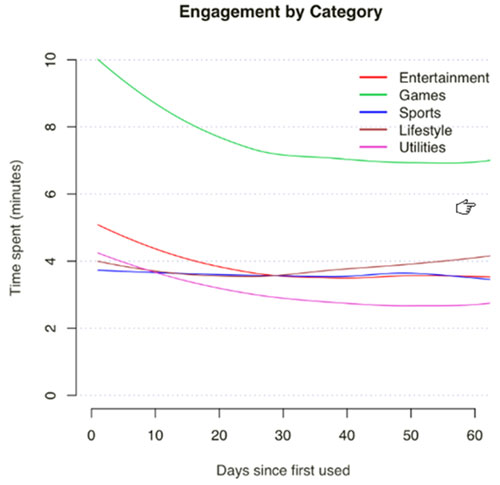
The Pinch Media research substantiates the leg up on "experience" given by iPhone games. For example, game apps get about 10 minutes of use on the first day, falling to only about 7 minutes of daily use out to as long as 60 days.
Whereas other categories like utilities, lifestyle and sports apps start out at about 4 minutes of use the first day. They remain at 3 or 4 minutes daily for the next 60 days. (Remember, these figures apply only to those people who continue to use the app. Many other people stop using the app altogether.)
When it comes to explaining the "flow" of peak experiences, we've learned that the designer needs to keep the experience easy enough that you don't get frustrated. If you have to stop to figure out how to use Amazon, for example, you simply won't feel the flow.
"Flow" from balance of skill and challenge
In fact, research on flow tells us that users (like you and me) need some challenges (otherwise, what's a game for?). But you also need some skill that matches the challenge.
So, that's the key to experiencing flow: if a task is too easy, well, that means it's not letting us "conquer" anything.
Imagine that if you had a computer that played Tap Tap Revenge for you? Not much of a challenge. This applies to those other websites as well, like building your Mini-Cooper or selecting that next outfit for your summer vacation.
Likewise, what if Amazon just showed you the best deal without the "shopping" experience? Would you enjoy just paying without at least examining your other choices just in case you found something that struck your fancy?
Notice these italicized words stretch our boundaries – which is what we want when shopping. After all, even "window shopping" has charms. We're learning what's available. That's an achievement right there.
Flow with the user experience game
So next time you check out new apps, understand the new game in town is "user experience". Finding an app is as much an experience as using your new iPhone app or using that special website.
Notice that Apple made one-stop app shopping a manageable challenge with iTunes and your iPhone app store. This innovation lets you spend your time looking and comparing, instead of getting stumped and befuddled just finding apps. That enhanced your "flow" right there. Apple gave you some windows nicely arrayed for window shopping.
Then, when you use your new app (whether for just one day or more), check out how well it pulls you out of the humdrum daily grind. Rising above the humdrum leads to "flow".
Remember the sports greats who report "automatic reactions" or "feeling free of the body" or "my arm just knew what to do". That's "being in the zone".
Maybe your day in the sun can happen when your next iPhone app or website generates some "flow". Let's hope the developers of your app or website have read this article and know how to help you experience some flow.
By the way, did you miss my usual obeisances to our research authors and their numeric findings? You can check them out in the references below.
I left them out just to give you more of that "good ol' flow".
References
Edutech Wiki, "Flow Theory".
Hoffman, Donna L. and Thomas P. Novak (1996), "Marketing in Hypermedia Computer-Mediated Environments: Conceptual Foundations," Journal of Marketing, 60 (July), 50-68.
Mack, C (2009) "Should iPhone Game Developers Give Their Apps Away?" Inside Network Inc. website.
Novak, Thomas P., Hoffman, Donna L., Dhachek, Adam (2003), "The Influence of Goal-Directed and Experiential Activities on Online Flow Experiences," Journal of Consumer Psychology, 13 (1 & 2) 3-16.
WebSiteOptimization.com, "Flow in Web Design".
Message from the CEO, Dr. Eric Schaffer — The Pragmatic Ergonomist

I grew up playing arcade games (because my family owned Play Land on Times Square). So it was pretty natural that I wondered why people would PAY to use computers in the arcade, and why they would need to be paid to use the computers where I worked at AT&T. I published that question in 1981, and no one cared. Because at the time it was a challenge to just make the hardware and software work. Making it fun was not on anyone's radar.
But today hardware and software is a given. And usability is a hygiene factor. It is a basic requirement to make things usable, and to be competitive things need to be fun (or at least persuasive). The other Dr. Schaffer in HFI (my son Noah) did his PhD on usability of computer games. Now he helps make even banking systems fun! And that is NOT just public banking, I'm talking about core banking applications. We are all ready to do it. Let's make work fun. Let's make applications fun.
Flow is just one part of the picture. But it is finally time that we get smart about the methods of designing engagement into even our most serious applications. Noah often reminds me that there is easy fun, hard fun, people fun, and serious fun. And we better get good at designing all that.
Leave a comment here
Reader comments
uxdesign.com
Customer-Centered Interactive
This a GREAT article. I've been wondering for ages how I or someone Jimi Hendrix in to a user experience topic. Why yes, I am experienced, thanks for asking. An Flow, too (read Csíkszentmihályi in '98). But both together? Very impressive.
For flow, there are a number of stars that need to align for it, some of which a designer can determine, some not (environment, user's comfort, satiated state, restedness, etc.). This is an area that designers of systems used for complex tasks really need to explore, focus on, and promote among our peers and partners. Undervalued.
Fantastic entry Mr. Schaffer!
Rod Morgan
Systems and Integration Office
The March 2010 issue disappoints.
As delighted as I am to see Jimi Hendrix' face almost anytime, anywhere, its use at the top of this column seems non sequitur if not downright exploitive.
A recent book reflects on the fact that the only album for which Jimi Hendrix had complete control did not sell well at the time, and was generally scorned by reviewers. It is unclear that he made an effort to "attract customers," preferring instead to play his latest music, thinking that songs just six months old were no longer "representative" of his current interests and capabilities.
Even your conversation about "high-roller" apps and "also-ran" apps points out that VERY FEW apps have lasting value.
Perhaps the objective is to get producers of all kinds, including Web developers, to consider the quality of their content first, and look at the sales charts last.
Jimi, after all, doesn't realize his most recent album hit the Top 10...
Wanda
Rod, really man... it was just a play on words, and an eyecatching one, at that.
Subscribe
Sign up to get our Newsletter delivered straight to your inbox
Privacy policy
Reviewed: 18 Mar 2014
This Privacy Policy governs the manner in which Human Factors International, Inc., an Iowa corporation (“HFI”) collects, uses, maintains and discloses information collected from users (each, a “User”) of its humanfactors.com website and any derivative or affiliated websites on which this Privacy Policy is posted (collectively, the “Website”). HFI reserves the right, at its discretion, to change, modify, add or remove portions of this Privacy Policy at any time by posting such changes to this page. You understand that you have the affirmative obligation to check this Privacy Policy periodically for changes, and you hereby agree to periodically review this Privacy Policy for such changes. The continued use of the Website following the posting of changes to this Privacy Policy constitutes an acceptance of those changes.
Cookies
HFI may use “cookies” or “web beacons” to track how Users use the Website. A cookie is a piece of software that a web server can store on Users’ PCs and use to identify Users should they visit the Website again. Users may adjust their web browser software if they do not wish to accept cookies. To withdraw your consent after accepting a cookie, delete the cookie from your computer.
Privacy
HFI believes that every User should know how it utilizes the information collected from Users. The Website is not directed at children under 13 years of age, and HFI does not knowingly collect personally identifiable information from children under 13 years of age online. Please note that the Website may contain links to other websites. These linked sites may not be operated or controlled by HFI. HFI is not responsible for the privacy practices of these or any other websites, and you access these websites entirely at your own risk. HFI recommends that you review the privacy practices of any other websites that you choose to visit.
HFI is based, and this website is hosted, in the United States of America. If User is from the European Union or other regions of the world with laws governing data collection and use that may differ from U.S. law and User is registering an account on the Website, visiting the Website, purchasing products or services from HFI or the Website, or otherwise using the Website, please note that any personally identifiable information that User provides to HFI will be transferred to the United States. Any such personally identifiable information provided will be processed and stored in the United States by HFI or a service provider acting on its behalf. By providing your personally identifiable information, User hereby specifically and expressly consents to such transfer and processing and the uses and disclosures set forth herein.
In the course of its business, HFI may perform expert reviews, usability testing, and other consulting work where personal privacy is a concern. HFI believes in the importance of protecting personal information, and may use measures to provide this protection, including, but not limited to, using consent forms for participants or “dummy” test data.
The Information HFI Collects
Users browsing the Website without registering an account or affirmatively providing personally identifiable information to HFI do so anonymously. Otherwise, HFI may collect personally identifiable information from Users in a variety of ways. Personally identifiable information may include, without limitation, (i)contact data (such as a User’s name, mailing and e-mail addresses, and phone number); (ii)demographic data (such as a User’s zip code, age and income); (iii) financial information collected to process purchases made from HFI via the Website or otherwise (such as credit card, debit card or other payment information); (iv) other information requested during the account registration process; and (v) other information requested by our service vendors in order to provide their services. If a User communicates with HFI by e-mail or otherwise, posts messages to any forums, completes online forms, surveys or entries or otherwise interacts with or uses the features on the Website, any information provided in such communications may be collected by HFI. HFI may also collect information about how Users use the Website, for example, by tracking the number of unique views received by the pages of the Website, or the domains and IP addresses from which Users originate. While not all of the information that HFI collects from Users is personally identifiable, it may be associated with personally identifiable information that Users provide HFI through the Website or otherwise. HFI may provide ways that the User can opt out of receiving certain information from HFI. If the User opts out of certain services, User information may still be collected for those services to which the User elects to subscribe. For those elected services, this Privacy Policy will apply.
How HFI Uses Information
HFI may use personally identifiable information collected through the Website for the specific purposes for which the information was collected, to process purchases and sales of products or services offered via the Website if any, to contact Users regarding products and services offered by HFI, its parent, subsidiary and other related companies in order to otherwise to enhance Users’ experience with HFI. HFI may also use information collected through the Website for research regarding the effectiveness of the Website and the business planning, marketing, advertising and sales efforts of HFI. HFI does not sell any User information under any circumstances.
Disclosure of Information
HFI may disclose personally identifiable information collected from Users to its parent, subsidiary and other related companies to use the information for the purposes outlined above, as necessary to provide the services offered by HFI and to provide the Website itself, and for the specific purposes for which the information was collected. HFI may disclose personally identifiable information at the request of law enforcement or governmental agencies or in response to subpoenas, court orders or other legal process, to establish, protect or exercise HFI’s legal or other rights or to defend against a legal claim or as otherwise required or allowed by law. HFI may disclose personally identifiable information in order to protect the rights, property or safety of a User or any other person. HFI may disclose personally identifiable information to investigate or prevent a violation by User of any contractual or other relationship with HFI or the perpetration of any illegal or harmful activity. HFI may also disclose aggregate, anonymous data based on information collected from Users to investors and potential partners. Finally, HFI may disclose or transfer personally identifiable information collected from Users in connection with or in contemplation of a sale of its assets or business or a merger, consolidation or other reorganization of its business.
Personal Information as Provided by User
If a User includes such User’s personally identifiable information as part of the User posting to the Website, such information may be made available to any parties using the Website. HFI does not edit or otherwise remove such information from User information before it is posted on the Website. If a User does not wish to have such User’s personally identifiable information made available in this manner, such User must remove any such information before posting. HFI is not liable for any damages caused or incurred due to personally identifiable information made available in the foregoing manners. For example, a User posts on an HFI-administered forum would be considered Personal Information as provided by User and subject to the terms of this section.
Security of Information
Information about Users that is maintained on HFI’s systems or those of its service providers is protected using industry standard security measures. However, no security measures are perfect or impenetrable, and HFI cannot guarantee that the information submitted to, maintained on or transmitted from its systems will be completely secure. HFI is not responsible for the circumvention of any privacy settings or security measures relating to the Website by any Users or third parties.
Correcting, Updating, Accessing or Removing Personal Information
If a User’s personally identifiable information changes, or if a User no longer desires to receive non-account specific information from HFI, HFI will endeavor to provide a way to correct, update and/or remove that User’s previously-provided personal data. This can be done by emailing a request to HFI at hfi@humanfactors.com. Additionally, you may request access to the personally identifiable information as collected by HFI by sending a request to HFI as set forth above. Please note that in certain circumstances, HFI may not be able to completely remove a User’s information from its systems. For example, HFI may retain a User’s personal information for legitimate business purposes, if it may be necessary to prevent fraud or future abuse, for account recovery purposes, if required by law or as retained in HFI’s data backup systems or cached or archived pages. All retained personally identifiable information will continue to be subject to the terms of the Privacy Policy to which the User has previously agreed.
Contacting HFI
If you have any questions or comments about this Privacy Policy, you may contact HFI via any of the following methods:
Human Factors International, Inc.
PO Box 2020
1680 highway 1, STE 3600
Fairfield IA 52556
hfi@humanfactors.com
(800) 242-4480
Terms and Conditions for Public Training Courses
Reviewed: 18 Mar 2014
Cancellation of Course by HFI
HFI reserves the right to cancel any course up to 14 (fourteen) days prior to the first day of the course. Registrants will be promptly notified and will receive a full refund or be transferred to the equivalent class of their choice within a 12-month period. HFI is not responsible for travel expenses or any costs that may be incurred as a result of cancellations.
Cancellation of Course by Participants (All regions except India)
$100 processing fee if cancelling within two weeks of course start date.
Cancellation / Transfer by Participants (India)
4 Pack + Exam registration: Rs. 10,000 per participant processing fee (to be paid by the participant) if cancelling or transferring the course (4 Pack-CUA/CXA) registration before three weeks from the course start date. No refund or carry forward of the course fees if cancelling or transferring the course registration within three weeks before the course start date.
Cancellation / Transfer by Participants (Online Courses)
$100 processing fee if cancelling within two weeks of course start date. No cancellations or refunds less than two weeks prior to the first course start date.
Individual Modules: Rs. 3,000 per participant ‘per module’ processing fee (to be paid by the participant) if cancelling or transferring the course (any Individual HFI course) registration before three weeks from the course start date. No refund or carry forward of the course fees if cancelling or transferring the course registration within three weeks before the course start date.
Exam: Rs. 3,000 per participant processing fee (to be paid by the participant) if cancelling or transferring the pre agreed CUA/CXA exam date before three weeks from the examination date. No refund or carry forward of the exam fees if requesting/cancelling or transferring the CUA/CXA exam within three weeks before the examination date.
No Recording Permitted
There will be no audio or video recording allowed in class. Students who have any disability that might affect their performance in this class are encouraged to speak with the instructor at the beginning of the class.
Course Materials Copyright
The course and training materials and all other handouts provided by HFI during the course are published, copyrighted works proprietary and owned exclusively by HFI. The course participant does not acquire title nor ownership rights in any of these materials. Further the course participant agrees not to reproduce, modify, and/or convert to electronic format (i.e., softcopy) any of the materials received from or provided by HFI. The materials provided in the class are for the sole use of the class participant. HFI does not provide the materials in electronic format to the participants in public or onsite courses.