
- About us
- Contact us: +1.641.472.4480, hfi@humanfactors.com
Cool stuff and UX resources



Wherefore Art Thou O Usability? – Cognitive lock-in to the rescue
Wherefore art thou O Usability?
I've enjoyed teaching HFI's series of CUA Certification Courses for many years now. Over 20 years of teaching, I got to meet a lot of people who were serious about usability – their organizations paid good money to get them trained. The organizations were "in love" with usability, so to speak. O usability, O usability.
But when I asked the class what their most serious issues were, their replies surprised me. The problem was more "political" than "operational". Their problem was convincing managers that usability offered true value – and should be incorporated into the design life cycle as a routine activity.
Yes, organizations send people to classes. Yes, organizations employ usability specialists. But NO, usability often has no priority and (surprisingly) remains ignored amidst the other pressures of business.
Are you in this boat? Are you astonished? For many of our readers this is no surprise.
How did this tragedy of love happen? Why do some organizations see usability as their future, but others can't find room to put it on a serious agenda? O Usability, wherefore art thou?
The missing link between usability and profitability
Turns out we can overcome some of these relationship prejudices. I'll share some research that shows a direct link between usability and site purchases across the e-commerce venues of travel, music and books.
For those of us developing our professional vocabulary, this research area covers the concept of "cognitive lock-in." Cognitive lock-in represents consumers whose shopping habits bring them back to a site enough to return again and again – they have "locked-in" to the ease of use of that site and make repeated purchases over time. (For example, are you an Amazon shopper, yet?)
That is, customers are motivated by usability (albeit unconsciously). These customers want to avoid the cognitive effort of learning how to shop at an alternative site. They have "cognitive lock-in" with your site. Perhaps you have the experience of cognitive lock-in yourself.
We can adopt an evolution metaphor to chart the steps of increasing management support for usability. That is, some managers miss seeing the link between your usability efforts and increased profitability for their web site. However, the following discussion on cognitive lock-in can support your claims that usability indeed contributes directly to greater profitability.
You now have “the missing link” to show your team.
Cognitive "lock-in" creates site loyalty
Although this phrase sounds academic, cognitive lock-in shows that you can obtain web site loyalty without using extrinsic rewards like frequent flyer points or discounted prices. Furthermore, cognitive lock-in gets you customer loyalty without requiring a positive attitude towards the product, trust in the product, or even superior functioning of the product.
Three marketing professors found that customers return to e-commerce web sites because they have already learned how to use the site and that it was easy to learn.
Going to a different site incurs greater effort (greater "cognitive costs") than re-using the site they already know. The outcome of liking a site and disliking change is called "cognitive lock-in".
The authors, Eric Johnson, Steven Bellman, and Gerald Lohse (2003) obtained a gold-mine of data from Media Metrix (now www.comscore.com) that covered internet usage for about 20,000 end-users (age 18-70) over a 12 month period in July, 1997-June, 1998. Although this is early in "internet time," the findings represent fundamental psychological processes that continue to hold true. Subsequent research by Murray and Häubl (2007) supports the original findings.
These authors suggest that the experience of "cognitive lock-in" provides significant competitive advantage for e-commerce.
Shoppers ahoy
The authors looked at the top selling sites of books (2 sites), music (4 sites), and travel (30 sites) because these market venues have the highest number of repeat visitors and repeat online purchases. This strategy enabled the authors to see how repeated visits affected both the visit time and the number of purchases made by a given site visitor.
When a gap of page views exceeded 15 minutes, the researchers assumed it was a separate visit. The median time between repeat visits was 6.2 days for books, and 4.2 days for music and travel. (Were these intense shoppers?) The authors examined the amount of time spent on each subsequent visit to the same site. What did they find?
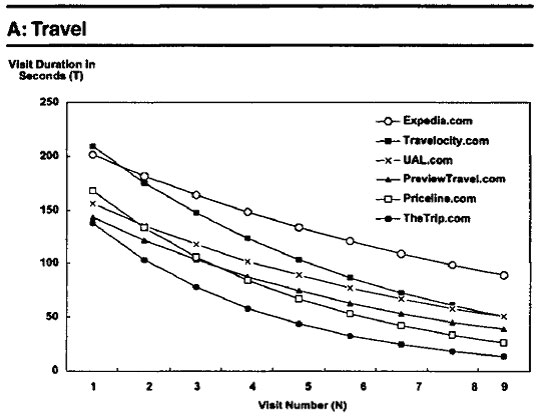
Site visits shorter over time = end-user "learning"
The data across all three shopping categories showed declines in visit duration times. This indicates that site visitors "learned" as they re-visited sites.
This practice phenomenon is well known as the "power law of learning", "learning curve" or the "experience curve effect". This decline in visit duration contradicts an oft-cited goal of web design called "sticky content". The latter probably has value in an advertising-model for generating web revenue. However, for e-commerce, shorter visits imply more productive use of time.
Notice that these curves are somewhat uniform. The regular decrease in duration of site visits supports the interpretation that return visitors were faster because of their prior exposure to the site. This represents the "learning curve".
"Show me the money" – faster learning rates pay off
This phrase from the popular movie "Jerry McGuire" sums up a lot of business goals. Where is the money in decreased visit duration?
Indeed, the researchers found for all three categories – books, music, and travel – that the learning rate (decrease in time on site) correlated with purchases. In fact, the faster the rate of learning (the steeper the curve), the greater the probability of purchasing the product.
Need we say more in defense of ease-of-use?
For the record, subsequent research by Murray and Häubl who we had mentioned early as supporting this theory, showed that decreased error rates played the biggest role in elevating "perceived usability". Thus, usability testing plays an important role in profit-making by detecting errors and improving designs before release to the public.
The benefit of initial ease of use
The researchers looked for other reasons for "cognitive lock-in" such as the initial experience with the web site. For two categories, music and travel, they found that the shorter the duration for the initial experience, the greater the probability of purchase.
This clearly indicates how ease-of-use improves earning power for those web sites.
All of these findings show that e-commerce site visitors remain motivated by the speed with which they achieve their purchase goal. Thus, both rapid learning and fast initial interaction constitute the "missing link" between persuasion and usability.
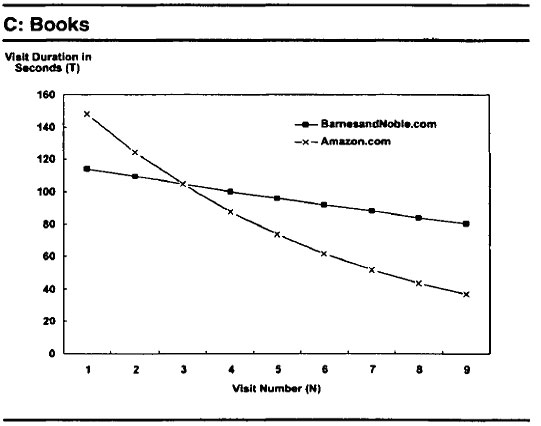
Interestingly, a comparison chart (below) of Amazon versus Barnes and Noble shows that although Barnes and Noble had a shorter duration initially, the overall learning curve for Amazon was far more efficient.
The authors indicate that the steep reduction in usage duration over several site visits supported Amazon's superiority in contemporary reviews at the time. Amazon put effort into making interaction efficient. For example, the "one-click" shopping method of Amazon ultimately caused Barnes and Noble to license that technique as well.
The full story in a single picture
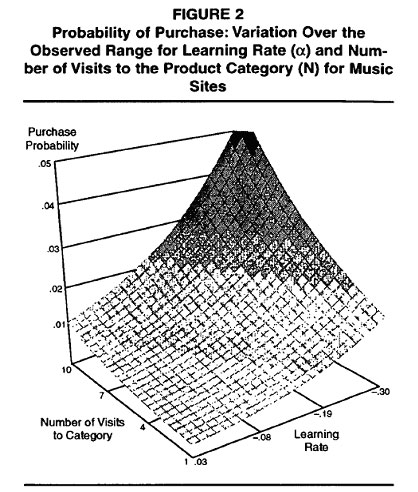
The authors wrap all these findings into a single graphic that tells a compelling story. The chart below shows purchasing relates strongly to the rate of learning ("Learning Rate") for music site. Similar results also hold true for travel.
How to read "learning rate". Each number, like .08, show how much the visit time is reduced when compared with the time required for some prior visit. For example, if the first visit required 100 seconds, and the learning rate is -.08, then the second subsequent visit will be 8 seconds less (that is, 8% less) than the preceding visit. If the learning rate is -.1, then the subsequent, 2nd visit requires 10% less time. After numerous visits, these savings get less and less (called "going asymptotic").
This chart shows that faster learning rates offer greater impact on purchases than the increases in number of visits. For example, on the fourth visit, increasing the learning rate from -.1 to -.2 (10% faster learning) doubles the probability of purchase from 1 percent to 2 percent. That's the power of usability.
Cognitive lock-in sells
Is this a picture worth showing your management? I think it may go a long way towards justifying your usability work. Give it a try. Let us know how it worked.
Our authors suggest that the greater the ease-of-use in a web site, the faster the rate of learning. They use the phrase "cognitive lock-in" to describe how end-users appreciate the faster rate of learning. That experience causes end-users to avoid going to other sites that offer the same product. End-users want to avoid using different navigation or different look and feel because it puts them back on the high-end of the learning curve.
The authors suggest that content can be refreshed often, but changes in site design and navigation should be reviewed carefully. Even copying the design features of a competitor may help – because it reinforces the familiarity that constitutes our collective "learning curve". This builds "cognitive lock-in" which in turn implies a base of loyal customers.
Therein lies the story of Barnes and Noble licensing the one-click method of Amazon. Barnes and Noble wanted to reduce the learning curve and share in Amazon's cognitive lock-in.
What is your key to speeding up cognitive lock-in? O usability, O usability, wherefore art thou, O usability?
References
Johnson, Eric J, Bellman, Steven, & Lohse, Gerald L, 2003. Cognitive lock-in and the power law of practice. Journal of Marketing 67, (Apr), 62-75.
Murray, Kyle B., Häubl, Gerald, 2007. Explaining cognitive lock-in: the role of skill-based habits of use in consumer choice. Journal of Consumer Research, 34 (1), 77-88.
Message from the CEO, Dr. Eric Schaffer — The Pragmatic Ergonomist

This research has to help with the core insight that usability is well worthwhile. It is amazing how many executives understand that customer-centricity is a core business objective, yet fail to do more than provide rousing speeches about being customer-centric.
So while this study illustrates the value of usability, we also need to bring home the need for a professional and "industrial strength" approach. Pithy speeches about customer centricity are inspirational. But we see real progress when our clients work on executive sponsorship, governance, organizational design, cultural change, staffing, training, certification, methods, standards, tools... and a plan that puts all this in place efficiently and systematically.
Leave a comment here
Reader comments
Daniel Cardenas
Sierra Media
Fascinating information. It's the justification we need to help beat the drum for good UX. Great article.
Qurie de Berk
easability.nl
The phrase 'customer lock-in' sounds pretty catchy, but if I try to sell this to a customer who doesn't directly sell items on the web like all the websites in the article seem to, then what do I tell them? How does this article apply to informative websites of companies without clear products?
Shivashankar Thiagarajan
Tata Consultancy Services
Well written and compelling piece of info. One doubt, though this could be a little out of context...what about intranet/internal applications/employee portals etc. How can the top echelons be convinced of the ROI in usability enhancements and other related projects, taken the fact that it's mostly for a closed focused group of employees / customer service reps / users who're well trained or get used by oft repeating the same tasks.
Patrick
I need to comment on an aspect of your article that has nothing to do with usability. It continues to astound me that thinking people embrace and disseminate the theory of macro-evolution. The theory is unproved, improvable, and indeed unscientific...and requires far more faith and imagination than any alternative I've ever heard. So why use the cliched "missing link" picture in your article? Why mix the art and science of usability with the fiction of the missing link aspect of the theory of evolution? Writing an article requires a disciplined approach; it requires you to balance facts, humor and other elements to grab and hold your reader's attention. Instead, you've annoyed and even offended this reader before I've read a single word of your article. (And as an epilogue, I imagine I'll be accused of everything from narrow-mindedness to fanaticism. But I'm not the one who believes that the incredible complexity, wonder and interdependencies of our universe happened by accident, so I can handle a few insults on that point...) I like being stimulated and challenged, but I don't like having my intelligence insulted. In the future, I respectfully ask that you choose your metaphors more carefully and thoughtfully.
Juan Lanus, Globant
This article is very valuable. First, it makes me remember how I stopped visiting an IBM site after a redesign that reorganized the content. I built a knowledge of the site paths and they changed it. I never learned the newer IA. Secondly, this information has to be lifted by those who build web analytics software. Once revealed, it does not seems very difficult to have it for one's site on a regular basis.
Subscribe
Sign up to get our Newsletter delivered straight to your inbox
Privacy policy
Reviewed: 18 Mar 2014
This Privacy Policy governs the manner in which Human Factors International, Inc., an Iowa corporation (“HFI”) collects, uses, maintains and discloses information collected from users (each, a “User”) of its humanfactors.com website and any derivative or affiliated websites on which this Privacy Policy is posted (collectively, the “Website”). HFI reserves the right, at its discretion, to change, modify, add or remove portions of this Privacy Policy at any time by posting such changes to this page. You understand that you have the affirmative obligation to check this Privacy Policy periodically for changes, and you hereby agree to periodically review this Privacy Policy for such changes. The continued use of the Website following the posting of changes to this Privacy Policy constitutes an acceptance of those changes.
Cookies
HFI may use “cookies” or “web beacons” to track how Users use the Website. A cookie is a piece of software that a web server can store on Users’ PCs and use to identify Users should they visit the Website again. Users may adjust their web browser software if they do not wish to accept cookies. To withdraw your consent after accepting a cookie, delete the cookie from your computer.
Privacy
HFI believes that every User should know how it utilizes the information collected from Users. The Website is not directed at children under 13 years of age, and HFI does not knowingly collect personally identifiable information from children under 13 years of age online. Please note that the Website may contain links to other websites. These linked sites may not be operated or controlled by HFI. HFI is not responsible for the privacy practices of these or any other websites, and you access these websites entirely at your own risk. HFI recommends that you review the privacy practices of any other websites that you choose to visit.
HFI is based, and this website is hosted, in the United States of America. If User is from the European Union or other regions of the world with laws governing data collection and use that may differ from U.S. law and User is registering an account on the Website, visiting the Website, purchasing products or services from HFI or the Website, or otherwise using the Website, please note that any personally identifiable information that User provides to HFI will be transferred to the United States. Any such personally identifiable information provided will be processed and stored in the United States by HFI or a service provider acting on its behalf. By providing your personally identifiable information, User hereby specifically and expressly consents to such transfer and processing and the uses and disclosures set forth herein.
In the course of its business, HFI may perform expert reviews, usability testing, and other consulting work where personal privacy is a concern. HFI believes in the importance of protecting personal information, and may use measures to provide this protection, including, but not limited to, using consent forms for participants or “dummy” test data.
The Information HFI Collects
Users browsing the Website without registering an account or affirmatively providing personally identifiable information to HFI do so anonymously. Otherwise, HFI may collect personally identifiable information from Users in a variety of ways. Personally identifiable information may include, without limitation, (i)contact data (such as a User’s name, mailing and e-mail addresses, and phone number); (ii)demographic data (such as a User’s zip code, age and income); (iii) financial information collected to process purchases made from HFI via the Website or otherwise (such as credit card, debit card or other payment information); (iv) other information requested during the account registration process; and (v) other information requested by our service vendors in order to provide their services. If a User communicates with HFI by e-mail or otherwise, posts messages to any forums, completes online forms, surveys or entries or otherwise interacts with or uses the features on the Website, any information provided in such communications may be collected by HFI. HFI may also collect information about how Users use the Website, for example, by tracking the number of unique views received by the pages of the Website, or the domains and IP addresses from which Users originate. While not all of the information that HFI collects from Users is personally identifiable, it may be associated with personally identifiable information that Users provide HFI through the Website or otherwise. HFI may provide ways that the User can opt out of receiving certain information from HFI. If the User opts out of certain services, User information may still be collected for those services to which the User elects to subscribe. For those elected services, this Privacy Policy will apply.
How HFI Uses Information
HFI may use personally identifiable information collected through the Website for the specific purposes for which the information was collected, to process purchases and sales of products or services offered via the Website if any, to contact Users regarding products and services offered by HFI, its parent, subsidiary and other related companies in order to otherwise to enhance Users’ experience with HFI. HFI may also use information collected through the Website for research regarding the effectiveness of the Website and the business planning, marketing, advertising and sales efforts of HFI. HFI does not sell any User information under any circumstances.
Disclosure of Information
HFI may disclose personally identifiable information collected from Users to its parent, subsidiary and other related companies to use the information for the purposes outlined above, as necessary to provide the services offered by HFI and to provide the Website itself, and for the specific purposes for which the information was collected. HFI may disclose personally identifiable information at the request of law enforcement or governmental agencies or in response to subpoenas, court orders or other legal process, to establish, protect or exercise HFI’s legal or other rights or to defend against a legal claim or as otherwise required or allowed by law. HFI may disclose personally identifiable information in order to protect the rights, property or safety of a User or any other person. HFI may disclose personally identifiable information to investigate or prevent a violation by User of any contractual or other relationship with HFI or the perpetration of any illegal or harmful activity. HFI may also disclose aggregate, anonymous data based on information collected from Users to investors and potential partners. Finally, HFI may disclose or transfer personally identifiable information collected from Users in connection with or in contemplation of a sale of its assets or business or a merger, consolidation or other reorganization of its business.
Personal Information as Provided by User
If a User includes such User’s personally identifiable information as part of the User posting to the Website, such information may be made available to any parties using the Website. HFI does not edit or otherwise remove such information from User information before it is posted on the Website. If a User does not wish to have such User’s personally identifiable information made available in this manner, such User must remove any such information before posting. HFI is not liable for any damages caused or incurred due to personally identifiable information made available in the foregoing manners. For example, a User posts on an HFI-administered forum would be considered Personal Information as provided by User and subject to the terms of this section.
Security of Information
Information about Users that is maintained on HFI’s systems or those of its service providers is protected using industry standard security measures. However, no security measures are perfect or impenetrable, and HFI cannot guarantee that the information submitted to, maintained on or transmitted from its systems will be completely secure. HFI is not responsible for the circumvention of any privacy settings or security measures relating to the Website by any Users or third parties.
Correcting, Updating, Accessing or Removing Personal Information
If a User’s personally identifiable information changes, or if a User no longer desires to receive non-account specific information from HFI, HFI will endeavor to provide a way to correct, update and/or remove that User’s previously-provided personal data. This can be done by emailing a request to HFI at hfi@humanfactors.com. Additionally, you may request access to the personally identifiable information as collected by HFI by sending a request to HFI as set forth above. Please note that in certain circumstances, HFI may not be able to completely remove a User’s information from its systems. For example, HFI may retain a User’s personal information for legitimate business purposes, if it may be necessary to prevent fraud or future abuse, for account recovery purposes, if required by law or as retained in HFI’s data backup systems or cached or archived pages. All retained personally identifiable information will continue to be subject to the terms of the Privacy Policy to which the User has previously agreed.
Contacting HFI
If you have any questions or comments about this Privacy Policy, you may contact HFI via any of the following methods:
Human Factors International, Inc.
PO Box 2020
1680 highway 1, STE 3600
Fairfield IA 52556
hfi@humanfactors.com
(800) 242-4480
Terms and Conditions for Public Training Courses
Reviewed: 18 Mar 2014
Cancellation of Course by HFI
HFI reserves the right to cancel any course up to 14 (fourteen) days prior to the first day of the course. Registrants will be promptly notified and will receive a full refund or be transferred to the equivalent class of their choice within a 12-month period. HFI is not responsible for travel expenses or any costs that may be incurred as a result of cancellations.
Cancellation of Course by Participants (All regions except India)
$100 processing fee if cancelling within two weeks of course start date.
Cancellation / Transfer by Participants (India)
4 Pack + Exam registration: Rs. 10,000 per participant processing fee (to be paid by the participant) if cancelling or transferring the course (4 Pack-CUA/CXA) registration before three weeks from the course start date. No refund or carry forward of the course fees if cancelling or transferring the course registration within three weeks before the course start date.
Cancellation / Transfer by Participants (Online Courses)
$100 processing fee if cancelling within two weeks of course start date. No cancellations or refunds less than two weeks prior to the first course start date.
Individual Modules: Rs. 3,000 per participant ‘per module’ processing fee (to be paid by the participant) if cancelling or transferring the course (any Individual HFI course) registration before three weeks from the course start date. No refund or carry forward of the course fees if cancelling or transferring the course registration within three weeks before the course start date.
Exam: Rs. 3,000 per participant processing fee (to be paid by the participant) if cancelling or transferring the pre agreed CUA/CXA exam date before three weeks from the examination date. No refund or carry forward of the exam fees if requesting/cancelling or transferring the CUA/CXA exam within three weeks before the examination date.
No Recording Permitted
There will be no audio or video recording allowed in class. Students who have any disability that might affect their performance in this class are encouraged to speak with the instructor at the beginning of the class.
Course Materials Copyright
The course and training materials and all other handouts provided by HFI during the course are published, copyrighted works proprietary and owned exclusively by HFI. The course participant does not acquire title nor ownership rights in any of these materials. Further the course participant agrees not to reproduce, modify, and/or convert to electronic format (i.e., softcopy) any of the materials received from or provided by HFI. The materials provided in the class are for the sole use of the class participant. HFI does not provide the materials in electronic format to the participants in public or onsite courses.