
- About us
- Contact us: +1.641.472.4480, hfi@humanfactors.com
Cool stuff and UX resources


Introduction
Psychologists and Economists who study how people make decisions describe two types of decisions: compensatory and non-compensatory.

Compensatory decisions
Compensatory decisions are rational decisions. They involve:
- identifying the complete set of attributes that could impact the success of choosing any of the available options – including both positive and negative impacts,
- assigning a relative importance to each attribute,
- computing an overall value for each option based on the impact of attribute and relative weight, and
- selecting the option with the best value.
In compensatory decisions, when the final values for attributes are computed, negative attributes can be compensated for by equal or higher value positive attributes. For instance, a plane ticket that costs $50 more (negative attribute) may ultimately be the better choice because it is a direct flight (positive attribute).
Compensatory decisions are rational. However, people don't make compensatory decisions. Collecting and comparing all of the necessary data is simply too labor intensive.
Non-compensatory strategies are heuristics for decision making
In reality, we typically make non-compensatory decisions. This happens when people:
- don't collect all the relevant information systematically,
- fail to consider the relative importance of various attributes, or
- do not trade off the benefits of some attributes against the deficits of others.
Non-compensatory decision making essentially shortcuts the compensatory process to make the decision making process easier. For instance, in the airline example above, decision makers may simply not collect information on all the relevant attributes. In our airline example, they may consider price but not stopovers or overall flight time.
Alternately, people may find the task of comparing the tradeoffs too much. Instead of weighing price against layover, they may adopt strategies like "drop the choice with negative attributes." Continuing the example, under this strategy the higher priced ticket goes without consideration of the longer travel time. In reality, human decisions all include non-compensatory decision strategies.
"Satisficing," introduced by Herbert A. Simon in his Models of Man in 1957, is a term that combines "satisfy" and "suffice". Satisficing is a non-compensatory decision strategy in which we select the first adequate option, failing to explore or consider the entire set of options. Web site users do this all the time when they quickly scan a page until they get to the first hopeful sounding link name and click that. In a compensatory process they would read all the possible links, identify the most promising one, and then click.
CompareNet
Jango
Decisions by design
Could thoughtful information design help users make better consumer choices? Seems like it should. One benefit of the Web is that it simplifies the task of comparison shopping across merchants. The task that used to involve walking back and forth across the mall can now be accomplished in a fraction of the time – without moving from your desk chair. Merchants can organize and present all of the relevant information right at our finger tips to make the decision making process even easier. With relatively minimal work we can use the Web to make a well researched, informed, and even more rational decisions, right?
Unfortunately, shopping sites are not always created with the goal of comparative decision making in mind. How many times have you been online and thought I should be able to make a much better decision, but the site doesn't let me compare...?
There are exceptions. Some sites try to help users make better, or more compensatory decisions. But, does it help?
In a recent study, Jedetski, Adelman and Yeo (2002) hypothesized that Web sites designed to make comparing alternatives easier would lead users to better (or more compensatory) decisions than Web sites that do not. Before starting the study, they briefed their participants on the difference between compensatory and non-compensatory decision strategies so that they could reflect on the decision strategies that they used. After the briefing, participants used two target Web sites (CompareNet and Jango) to select items to purchase.
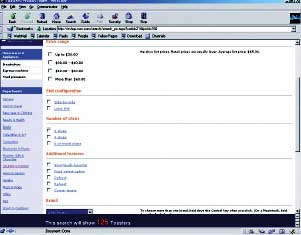
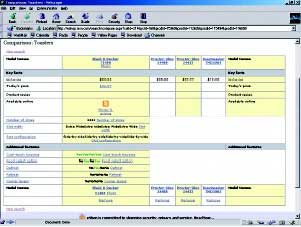
CompareNet allowed users to specify and display attributes side-by-side, and then compare among the alternatives. The site also facilitated comparison by providing the ability to sort on criteria such as price or reviews. Columns of attributes could easily be added or removed.
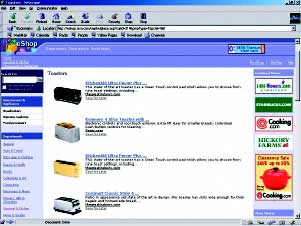
In contrast, Jango presented alternatives in a list for users to sort, but direct comparison required clicking deeper into the site, printing pages, or taking notes on the side. On Jango comparison was possible, but it certainly was not made easy.
Participants shopped independently for answering machines, baby monitors, golf clubs, and toasters. Data was collected using the "think-aloud" protocol. In this process participants think out loud while they shop so that the experimenters can note which attributes are noticed and considered. The "think aloud" procedure provides the experimenters a window to some of the mental processes of how participants made their decisions.
At the end of each "shopping" task, participants and researchers independently indicated whether the participant had used compensatory or non-compensatory strategies for that trial.
Both the researchers and participants agreed that participants were significantly more likely to use a compensatory strategy on CompareNet than on Jango.
Assuming that decision effort is relatively constant within individuals, these findings indicate that site design influences the quality of the participants' decisions. By presenting the information in a format that supported the selection and comparison of critical attributes, CompareNet clearly increased the use of compensatory decision strategies. In economic terms, participants made better decisions when they were using CompareNet.
Participants also reported greater satisfaction with CompareNet. While this is not surprising (we like to think we make good decisions), it is important. The perception that a site is helping or hindering customers to make better decisions, ultimately has impact on brand.
It's not rocket science...
Jedetski and colleague's work shows that the way information is presented on sites influences users decision-making processes. Users recognize when they are making good decisions (as opposed to satisficing) and they prefer sites that help them do that.
Other Web site options that support positive decision making include:
- sorting by price (which entails showing the price...something that sites STILL regularly fail to do!),
- prioritizing decision attributes so that critical options (e.g., price or travel time) appear early, and
- providing assistance or information to help shoppers unfamiliar with a product determine what the relevant parameters of consideration might be (e.g., in Jedetski's study, some participants were not familiar with what to consider when shopping for baby monitors.)
At a time in which many sites still bury prices, merchants and site designers who appreciate the usability of site interactions, and its effect on their brand, are starting to think in more sophisticated ways to support consumer decision making. Users feel better about themselves when they think they've made a solid and well considered decision. That halo may well extend to the merchant in the form of site loyalty.
References
Jedetski, J. Adelman, L., & Yeo, C. (2002). How web site decision technology affects consumers. IEEE Internet Computing, 6(2), 72-79.
Message from the CEO, Dr. Eric Schaffer — The Pragmatic Ergonomist

Yes. People are systematically bad at making decisions. This can be an opportunity for profit (Look how the gaming industry succeeds because people generally overestimate the likelihood of very unlikely events – like winning the Lottery).
We actually don't design eCommerce sites for good and rational decisions by consumers. We design them for PROFIT. Therefore we can benefit from the tendency for non-compensatory decision making. Putting the high margin choices first is a simple but lucrative example. We might even make the comparison difficult to favor the higher margin choices. By drawing the user down into the site to get a price, we might get them to buy an item without potentially embarrassing comparisons. It might be simply too much work to transverse the site to view the alternative.
But would customers appreciate and return more often to a site designed to support more compensatory decision making? Sites like Amazon prove that customers value information that helps them feel confident in their decisions (even having occasional bad recommendations to give one a solid sense of impartiality). They also DO provide comparison functions (which are probably rarely used). But my suspicion is that customers value reasonable protection from bad decisions and an emotional FEEL of good decision support. They value feeling part of a buying community. This is probably more important than a solid presentation of facts.
Leave a comment here
Reader comments
Dara McLaughlin Project Webmaster Boeing IDS
This was a great issue. Case in point, compare the Toyota car site with the Honda car site. I was looking for a car recently, and mainly want to choose between Toyota and Honda. The Toyota car site allows me to rank all their models vs. cost or mpg or seating. The Honda site only shows price in a comparison screen. Living in LA makes mpg critical information. I felt much more inclined to go buy a Toyota car because I feel like their site gives me the decision criteria I need in an easy to find format.
Toyota: click on the top bar Vehicles, then Model selector
Honda: and click on the Honda icon on the right, and then select the all models link on the right
Ray Williamson
Consulting Engineer
I've long used a "compensatory decision process" without knowing it was called that, and for large decisions will use a spreadsheet. I see "satisficing" as either consistent with that process, or at the very worst lazy, but not naturally at odds.
It seems to me that comparison shopping has value – either positive or negative – in the decision process the same as other factors listed: It takes time, and can be either enjoyable or not. Depending on the perceived value of time in a situation, people will behave differently.
Comparison shopping for food items by price has a positive value for the lower income shopper. Comparison shopping for ingredients has a positive value for the health-conscious consumer. It has a negative value based on the time investment for the person on lunch hour, where a decision NOW means more time for the individual.
Comparison shopping for hobby items such as fishing reels almost always has a positive value, because hobbies are essentially pastimes and the shopping process extends the pursuit without substantially increasing the cost.
The goal should be for a Web site designer or business owner to first define their clientele and facilitate the process accordingly. The Tire Rack is a good example. The consumer can simply identify their car and their climate, and get two or three recommendations and an order form. The enthusiast can spend days searching the database of specifications and reviews, and even see how the choice will look on their car.
Subscribe
Sign up to get our Newsletter delivered straight to your inbox
Privacy policy
Reviewed: 18 Mar 2014
This Privacy Policy governs the manner in which Human Factors International, Inc., an Iowa corporation (“HFI”) collects, uses, maintains and discloses information collected from users (each, a “User”) of its humanfactors.com website and any derivative or affiliated websites on which this Privacy Policy is posted (collectively, the “Website”). HFI reserves the right, at its discretion, to change, modify, add or remove portions of this Privacy Policy at any time by posting such changes to this page. You understand that you have the affirmative obligation to check this Privacy Policy periodically for changes, and you hereby agree to periodically review this Privacy Policy for such changes. The continued use of the Website following the posting of changes to this Privacy Policy constitutes an acceptance of those changes.
Cookies
HFI may use “cookies” or “web beacons” to track how Users use the Website. A cookie is a piece of software that a web server can store on Users’ PCs and use to identify Users should they visit the Website again. Users may adjust their web browser software if they do not wish to accept cookies. To withdraw your consent after accepting a cookie, delete the cookie from your computer.
Privacy
HFI believes that every User should know how it utilizes the information collected from Users. The Website is not directed at children under 13 years of age, and HFI does not knowingly collect personally identifiable information from children under 13 years of age online. Please note that the Website may contain links to other websites. These linked sites may not be operated or controlled by HFI. HFI is not responsible for the privacy practices of these or any other websites, and you access these websites entirely at your own risk. HFI recommends that you review the privacy practices of any other websites that you choose to visit.
HFI is based, and this website is hosted, in the United States of America. If User is from the European Union or other regions of the world with laws governing data collection and use that may differ from U.S. law and User is registering an account on the Website, visiting the Website, purchasing products or services from HFI or the Website, or otherwise using the Website, please note that any personally identifiable information that User provides to HFI will be transferred to the United States. Any such personally identifiable information provided will be processed and stored in the United States by HFI or a service provider acting on its behalf. By providing your personally identifiable information, User hereby specifically and expressly consents to such transfer and processing and the uses and disclosures set forth herein.
In the course of its business, HFI may perform expert reviews, usability testing, and other consulting work where personal privacy is a concern. HFI believes in the importance of protecting personal information, and may use measures to provide this protection, including, but not limited to, using consent forms for participants or “dummy” test data.
The Information HFI Collects
Users browsing the Website without registering an account or affirmatively providing personally identifiable information to HFI do so anonymously. Otherwise, HFI may collect personally identifiable information from Users in a variety of ways. Personally identifiable information may include, without limitation, (i)contact data (such as a User’s name, mailing and e-mail addresses, and phone number); (ii)demographic data (such as a User’s zip code, age and income); (iii) financial information collected to process purchases made from HFI via the Website or otherwise (such as credit card, debit card or other payment information); (iv) other information requested during the account registration process; and (v) other information requested by our service vendors in order to provide their services. If a User communicates with HFI by e-mail or otherwise, posts messages to any forums, completes online forms, surveys or entries or otherwise interacts with or uses the features on the Website, any information provided in such communications may be collected by HFI. HFI may also collect information about how Users use the Website, for example, by tracking the number of unique views received by the pages of the Website, or the domains and IP addresses from which Users originate. While not all of the information that HFI collects from Users is personally identifiable, it may be associated with personally identifiable information that Users provide HFI through the Website or otherwise. HFI may provide ways that the User can opt out of receiving certain information from HFI. If the User opts out of certain services, User information may still be collected for those services to which the User elects to subscribe. For those elected services, this Privacy Policy will apply.
How HFI Uses Information
HFI may use personally identifiable information collected through the Website for the specific purposes for which the information was collected, to process purchases and sales of products or services offered via the Website if any, to contact Users regarding products and services offered by HFI, its parent, subsidiary and other related companies in order to otherwise to enhance Users’ experience with HFI. HFI may also use information collected through the Website for research regarding the effectiveness of the Website and the business planning, marketing, advertising and sales efforts of HFI. HFI does not sell any User information under any circumstances.
Disclosure of Information
HFI may disclose personally identifiable information collected from Users to its parent, subsidiary and other related companies to use the information for the purposes outlined above, as necessary to provide the services offered by HFI and to provide the Website itself, and for the specific purposes for which the information was collected. HFI may disclose personally identifiable information at the request of law enforcement or governmental agencies or in response to subpoenas, court orders or other legal process, to establish, protect or exercise HFI’s legal or other rights or to defend against a legal claim or as otherwise required or allowed by law. HFI may disclose personally identifiable information in order to protect the rights, property or safety of a User or any other person. HFI may disclose personally identifiable information to investigate or prevent a violation by User of any contractual or other relationship with HFI or the perpetration of any illegal or harmful activity. HFI may also disclose aggregate, anonymous data based on information collected from Users to investors and potential partners. Finally, HFI may disclose or transfer personally identifiable information collected from Users in connection with or in contemplation of a sale of its assets or business or a merger, consolidation or other reorganization of its business.
Personal Information as Provided by User
If a User includes such User’s personally identifiable information as part of the User posting to the Website, such information may be made available to any parties using the Website. HFI does not edit or otherwise remove such information from User information before it is posted on the Website. If a User does not wish to have such User’s personally identifiable information made available in this manner, such User must remove any such information before posting. HFI is not liable for any damages caused or incurred due to personally identifiable information made available in the foregoing manners. For example, a User posts on an HFI-administered forum would be considered Personal Information as provided by User and subject to the terms of this section.
Security of Information
Information about Users that is maintained on HFI’s systems or those of its service providers is protected using industry standard security measures. However, no security measures are perfect or impenetrable, and HFI cannot guarantee that the information submitted to, maintained on or transmitted from its systems will be completely secure. HFI is not responsible for the circumvention of any privacy settings or security measures relating to the Website by any Users or third parties.
Correcting, Updating, Accessing or Removing Personal Information
If a User’s personally identifiable information changes, or if a User no longer desires to receive non-account specific information from HFI, HFI will endeavor to provide a way to correct, update and/or remove that User’s previously-provided personal data. This can be done by emailing a request to HFI at hfi@humanfactors.com. Additionally, you may request access to the personally identifiable information as collected by HFI by sending a request to HFI as set forth above. Please note that in certain circumstances, HFI may not be able to completely remove a User’s information from its systems. For example, HFI may retain a User’s personal information for legitimate business purposes, if it may be necessary to prevent fraud or future abuse, for account recovery purposes, if required by law or as retained in HFI’s data backup systems or cached or archived pages. All retained personally identifiable information will continue to be subject to the terms of the Privacy Policy to which the User has previously agreed.
Contacting HFI
If you have any questions or comments about this Privacy Policy, you may contact HFI via any of the following methods:
Human Factors International, Inc.
PO Box 2020
1680 highway 1, STE 3600
Fairfield IA 52556
hfi@humanfactors.com
(800) 242-4480
Terms and Conditions for Public Training Courses
Reviewed: 18 Mar 2014
Cancellation of Course by HFI
HFI reserves the right to cancel any course up to 14 (fourteen) days prior to the first day of the course. Registrants will be promptly notified and will receive a full refund or be transferred to the equivalent class of their choice within a 12-month period. HFI is not responsible for travel expenses or any costs that may be incurred as a result of cancellations.
Cancellation of Course by Participants (All regions except India)
$100 processing fee if cancelling within two weeks of course start date.
Cancellation / Transfer by Participants (India)
4 Pack + Exam registration: Rs. 10,000 per participant processing fee (to be paid by the participant) if cancelling or transferring the course (4 Pack-CUA/CXA) registration before three weeks from the course start date. No refund or carry forward of the course fees if cancelling or transferring the course registration within three weeks before the course start date.
Cancellation / Transfer by Participants (Online Courses)
$100 processing fee if cancelling within two weeks of course start date. No cancellations or refunds less than two weeks prior to the first course start date.
Individual Modules: Rs. 3,000 per participant ‘per module’ processing fee (to be paid by the participant) if cancelling or transferring the course (any Individual HFI course) registration before three weeks from the course start date. No refund or carry forward of the course fees if cancelling or transferring the course registration within three weeks before the course start date.
Exam: Rs. 3,000 per participant processing fee (to be paid by the participant) if cancelling or transferring the pre agreed CUA/CXA exam date before three weeks from the examination date. No refund or carry forward of the exam fees if requesting/cancelling or transferring the CUA/CXA exam within three weeks before the examination date.
No Recording Permitted
There will be no audio or video recording allowed in class. Students who have any disability that might affect their performance in this class are encouraged to speak with the instructor at the beginning of the class.
Course Materials Copyright
The course and training materials and all other handouts provided by HFI during the course are published, copyrighted works proprietary and owned exclusively by HFI. The course participant does not acquire title nor ownership rights in any of these materials. Further the course participant agrees not to reproduce, modify, and/or convert to electronic format (i.e., softcopy) any of the materials received from or provided by HFI. The materials provided in the class are for the sole use of the class participant. HFI does not provide the materials in electronic format to the participants in public or onsite courses.