
- About us
- Contact us: +1.641.472.4480, hfi@humanfactors.com
Cool stuff and UX resources



To See Is To Conquer, Or Is It?
Introduction
On a daily basis, most of us probably repeat to ourselves the psychological truth of Julius Caesar's famous phrase "I came, I saw, I conquered" ("Veni, vidi, vici").
When approaching rush hour traffic, what do we think? (I'm here, I see the traffic, I will survive).
When approaching tax season, what do we think? (It's here, I see the forms, I'll fill them in).
When getting married, having a child, burying a loved one? (I'm here, it's happening, it will all work out).
Sheer optimism has survival value when we deal with topics where we lack expertise.
Research even shows that entrepreneurs tend to have more optimism than the general public. How else to survive the rigors of starting a business that you never started before?
But do we expect optimism alone to solve the problem of providing surgery on a brain tumor? Or solve the issues of global economic contraction?
In the case of specialized knowledge, we know we must step more carefully. We probably can abandon optimism in favor of a humble confession that someone else knows better.
So, now we can ask you this question: when it comes to solving the problems of usability, does your manager invoke "To See Is To Conquer" or do they ask "Give Me Your Expertise".

The challenge of "Expertise" vs "To see is to conquer"
I'm sure we've all had the experience of telling someone a tip about interface design and we hear the response "but that's not the way I see it – we should do it THIS way".
For example, yesterday I reviewed a corporate business application that resided in a Web browser. The home page had a search component along with other functions on the page.
I indicated to my friend who had developed the page that the user would benefit from seeing a dark border around the "action button" that triggers the search. We know this as the "default" action triggered when selecting the Enter key.
My developer friend explained his reluctance to use the darker default border because, as he said, "it's in a browser." "Browsers don't use default indicators like that", he said.
I replied, "but it's clearly an application and our users will expect to know which button gets activated when they press the Enter key."
Without repeating our entire conversation, I must admit there were elements of truth in his observations. For example, I just now checked the Google search page, and see that indeed, there is no default symbol around the "Google Search" button that distinguishes it from the "I'm Feeling Lucky" button.
What was the Google designer thinking? Well – in such a simple case, it just didn't matter! (Or maybe, they just didn't think about it.)
Do I get nervous? Should I revise my theory about putting a dark border around the default button just because Google didn't do it?
There is an answer. But first I need to share some facts about human nature that help you address similar issues with your own development team and managers.
Is the Dunning-Kruger Effect at your job site?
It turns out that we can expect untrained colleagues and co-workers to draw wrong conclusions when talking about usability issues dear to our hearts. And we can expect them to feel their opinions have the weight of truth and justice.
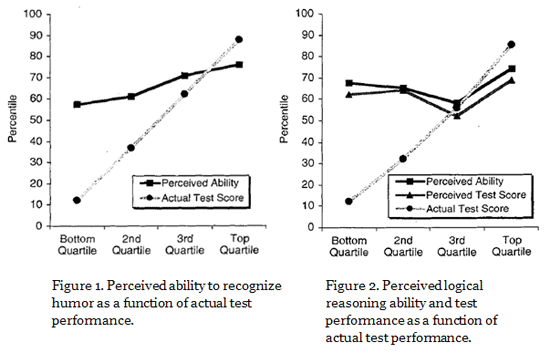
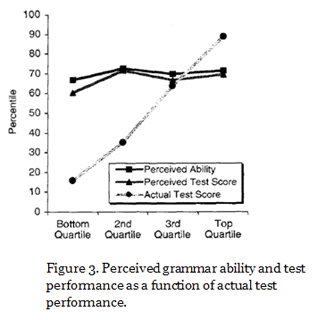
Research published in 1999 by Justin Kruger and David Dunning shows that individuals who fell within the bottom 25% of those reporting knowledge in a given topic still tended to place themselves in the "above average knowledge" category. Does that sound familiar?
For example, participants were given quizzes that separately tested their sense of humor, grammar, and logic. These are general skills for which we all have "experience" and presumably some competence to judge.
They were also asked to estimate their skill level compared to other people taking the same set of quizzes.
When looking at the 25% of the participants who scored the lowest, their average quiz scores fell around the bottom 10-12th percent of the possible scores. Meanwhile, those very same participants predicted their own scores would fall above average – their scores would rank as high as 58 to 67 percent of the other participants' scores. Quite a contrast.
Does this remind you of "To see is to conquer"? These individuals were quite optimistic about their skills in humor, grammar and logic.
The authors suggest that "Not only do they reach erroneous conclusions and make unfortunate choices, but their incompetence robs them of the ability to realize it."
Meanwhile, what about those participants whose quiz scores fell in the top 25% of scores? How did their self-estimates compare with their scores?
Understanding usability politics
Do the charts and research above remind you of the adage: when a teenager, your parents know very little. But as an adult, you marvel at your parent's wisdom?
Or, recall the proverb, "a little knowledge is a dangerous thing". Perhaps you run into this every day at work. It's called the "politics of usability". Perhaps this is the competition that provides the hardest challenges.
How do you handle this form of competition – the politics of usability?
So far, it looks like we can answer this question by choosing "To See is to Conquer" or we can be modest and ask if there is more to be learned in solving this problem. The choice is ours.
Our two authors oblige with further research that shows us a useful solution. Let us learn.
Make your competition competent
In this context, the authors studied the effect of training participants in logical reasoning skills. They wondered if the lack of self-knowledge about poor performance on the quiz could be corrected by training in the topic.
The authors administered a short logic test to 140 participants, collecting both the actual performance scores and the participant estimates of their comparative skills.
Then the authors instructed 70 of them using a standard logic reasoning packet while the other 70 engaged in a filler task that took the same amount of time (about 10 minutes – not much time if you think about it).
Subsequently, all participants reviewed their own tests and indicated which problems they had answered correctly and which incorrectly.
- Among those who received training, participants with the bottom 25% of scores gave more realistic estimates of their skills.
- Results showed that before training, they felt their ability was as good as at least 55% of others, whereas after training, they changed that to being as good as at least 44% of others.
- Similarly, they revised their estimates of correct answers from 5.3 questions being correct (out of 10) to only 1 problem being correctly answered.
- Among the untrained group, the researchers found no real changes in estimates of their ability or test performance.
- For participants among the top 25% of scores, the training motivated them to change their performance estimate from being as good as 78% of participants to a higher 87% of other participants.
- Their actual scores placed them being as good as 90% of all the participants on average.
What does all this mean for you as a usability expert dealing with colleagues and managers?
Simply put, "train them".
"Forewarned is forearmed"
This simple proverb provides us a simple agenda.
- To get appreciation for your usability expertise and usability work, your colleagues and managers must know what is at stake. They must learn about the impact of usability problems and the ROI of solving them.
- They must see that solutions based on usability science are indeed better than others based on intuition and gut feel. (Show before and after pictures.)
- They must learn that end-users are different than they are. (How do you teach that? Show videos of your usability tests.)
- They must learn that end-user expectations and habits can be met. But you must show examples that this happens only if developers agree to standardization and the extra work entailed in reading those standards. (Show examples of inconsistent button names and button positions, etc.)
- They must learn the science of counting keystrokes and mouse clicks when designing a task-flow. (Less is often more.)
- They must learn that a search page put up by Google is different than a search screen that appears in your flag-ship corporate application. (Recall my experience given early in this article. By the way, the solution is to ask "what expectations have our end-users developed from using Microsoft Office applications like Excel and Word?" Clearly, they expect a default indicator.)
Your self-talk pep-talk
We all have our inner scripting that unreels daily when confronted with frustrating events.
Promoting usability and gaining credibility for your work provides challenges no different than many occupations. Consider the doctor who hopes that their patient takes the blood-pressure medication regularly or enrolls in a meditation program to reduce hypertension.
This doctor faces the same dilemma of the patient being overconfident in their own knowledge about their illness.
Across many occupations, we see the conflicts between these two attitudes: "To See Is To Conquer" confronts "Gives Me Your Expertise".
But, as we saw above, increased knowledge about the domain, whether it be logic, usability, or medical issues of hypertension, brings the client into contact with more realistic thinking.
By the way, that's the same solution Julius Caesar brought when he came, saw, and conquered. He was an expert military tactician, not a novice with a surplus of bravery.
- This means that you, as the usability expert have the right "To See And Conquer". You have a background steeped in a scientific approach. (You read these HFI newsletters.)
- Relinquish some of that modesty our two researchers found present among the top 25% of participants. Let your light shine. Your quiet confidence communicates as much as your insights if not more.
Meanwhile, for your usability practice, consider these reminders….
- Train your clients one way or the other: short conversational tips, short emails with links to usability newsletters and tips, photocopies of articles, before-and-after stories.
- As a friend recently shared with me: focus on relationships. Build friendships first. The advice can follow later. Let people know you are interested in them – not just interested in telling them what to do.
- Appreciate the insights of your clients. Even their "gut feel" stories can have some truth. Accept that truth. Agree with their insight – in the sense that it reflects a genuine insight from their experience. Meanwhile, reflect on the idea that other domains of experience exist – such as the end-user experiences you hear daily. Ask your clients how they feel about those other reported experiences. Everyone has a right to their feelings, even if it differs from yours. Accept those feelings. Deal with remaining issues through usability testing.
- Speak politically. Although this is a big topic, here are some tips:
- Refer to usability research, best practices, industry standards, and results of your usability testing.
- Avoid saying "I think x, y, and z". If your opinion is the key, then anyone else's opinion is also the key. Usability is not an opinion-based science. Usability is based on data, data, and data.
- Get that data from training courses, usability testing, and reading research. Use sources like HFI's Design Newsletter and Jakob Neilsen's www.alertbox.com. Read the UPA Journal. Read the Wichita SURL Usability News research. E-mail them to others.
- Get data from counting mouse clicks and keystrokes. Create taskflow diagrams where you can illustrate the bad (with many steps) versus the good (with few steps).
- Get credentials that show you know the data behind usability. If you don't have an MA or PhD in psychology or usability-related fields, then at least get your Certified Usability Analyst credential.
- Refer to usability research, best practices, industry standards, and results of your usability testing.
The adventure awaits.
Go, see, and conquer.
Be well.
References
Ehrlinger, Joyce; Johnson, Kerri; Banner, Matthew; Dunning, David; and Kruger, Justin, 2008. Why the unskilled are unaware: Further explorations of (absent) self-insight among the incompetent. Organizational Behavior and Human Decision Processes 105, 98-121.
Kruger, Justin and Dunning, David 1999. Unskilled and unaware of it: how difficulties in recognizing one's own incompetence lead to inflated self-assessments Journal of Personality and Social Psychology. 77, (6), 1121-1134. (Republished online, 2009: Psychology 1, 30-46)
Wikipedia. Last update 29 June, 2010. Dunning-Kruger Effect. Downloaded 29 June, 2010.
Message from the CEO, Dr. Eric Schaffer — The Pragmatic Ergonomist

I've been going around the world helping organizations set up serious UX practices and I see this effect from Washington to Melbourne. It might be the biggest impediment to mature UX.
Executives and managers armed with perhaps a few books decide to charge ahead with some training, or a standard, or some other piecemeal approach. They often ignore their more sophisticated, if lower pay-grade, co-workers who stand by saddened and erroneously humble about their greater knowledge.
Education helps if you can get it in place in time. And EVERY UX professional should collect a handful of counter intuitive examples to share in those educational moments.
Leave a comment here
Reader comments
Wanda Lipscomb
JWT
Thanks Dr. Schaffer, your newsletter is spot on with my challenges. Although I've read and heard a lot of this when attending HFI classes, it's a great help to read this and it gives me a little more confidence. Keep it coming!
Ron Sova
Sova Consulting Group, LLC
Excellent article John! The way you explain the problem, it's overall solution and then the tools to make that solution happen, is very clear and easy to digest. Thanks for the great info, Ron
Ashok
MIMOS
Nice article. Thanks for the confidence to share some of the mouse click data i collected on a particular project with higher management.
Subscribe
Sign up to get our Newsletter delivered straight to your inbox
Privacy policy
Reviewed: 18 Mar 2014
This Privacy Policy governs the manner in which Human Factors International, Inc., an Iowa corporation (“HFI”) collects, uses, maintains and discloses information collected from users (each, a “User”) of its humanfactors.com website and any derivative or affiliated websites on which this Privacy Policy is posted (collectively, the “Website”). HFI reserves the right, at its discretion, to change, modify, add or remove portions of this Privacy Policy at any time by posting such changes to this page. You understand that you have the affirmative obligation to check this Privacy Policy periodically for changes, and you hereby agree to periodically review this Privacy Policy for such changes. The continued use of the Website following the posting of changes to this Privacy Policy constitutes an acceptance of those changes.
Cookies
HFI may use “cookies” or “web beacons” to track how Users use the Website. A cookie is a piece of software that a web server can store on Users’ PCs and use to identify Users should they visit the Website again. Users may adjust their web browser software if they do not wish to accept cookies. To withdraw your consent after accepting a cookie, delete the cookie from your computer.
Privacy
HFI believes that every User should know how it utilizes the information collected from Users. The Website is not directed at children under 13 years of age, and HFI does not knowingly collect personally identifiable information from children under 13 years of age online. Please note that the Website may contain links to other websites. These linked sites may not be operated or controlled by HFI. HFI is not responsible for the privacy practices of these or any other websites, and you access these websites entirely at your own risk. HFI recommends that you review the privacy practices of any other websites that you choose to visit.
HFI is based, and this website is hosted, in the United States of America. If User is from the European Union or other regions of the world with laws governing data collection and use that may differ from U.S. law and User is registering an account on the Website, visiting the Website, purchasing products or services from HFI or the Website, or otherwise using the Website, please note that any personally identifiable information that User provides to HFI will be transferred to the United States. Any such personally identifiable information provided will be processed and stored in the United States by HFI or a service provider acting on its behalf. By providing your personally identifiable information, User hereby specifically and expressly consents to such transfer and processing and the uses and disclosures set forth herein.
In the course of its business, HFI may perform expert reviews, usability testing, and other consulting work where personal privacy is a concern. HFI believes in the importance of protecting personal information, and may use measures to provide this protection, including, but not limited to, using consent forms for participants or “dummy” test data.
The Information HFI Collects
Users browsing the Website without registering an account or affirmatively providing personally identifiable information to HFI do so anonymously. Otherwise, HFI may collect personally identifiable information from Users in a variety of ways. Personally identifiable information may include, without limitation, (i)contact data (such as a User’s name, mailing and e-mail addresses, and phone number); (ii)demographic data (such as a User’s zip code, age and income); (iii) financial information collected to process purchases made from HFI via the Website or otherwise (such as credit card, debit card or other payment information); (iv) other information requested during the account registration process; and (v) other information requested by our service vendors in order to provide their services. If a User communicates with HFI by e-mail or otherwise, posts messages to any forums, completes online forms, surveys or entries or otherwise interacts with or uses the features on the Website, any information provided in such communications may be collected by HFI. HFI may also collect information about how Users use the Website, for example, by tracking the number of unique views received by the pages of the Website, or the domains and IP addresses from which Users originate. While not all of the information that HFI collects from Users is personally identifiable, it may be associated with personally identifiable information that Users provide HFI through the Website or otherwise. HFI may provide ways that the User can opt out of receiving certain information from HFI. If the User opts out of certain services, User information may still be collected for those services to which the User elects to subscribe. For those elected services, this Privacy Policy will apply.
How HFI Uses Information
HFI may use personally identifiable information collected through the Website for the specific purposes for which the information was collected, to process purchases and sales of products or services offered via the Website if any, to contact Users regarding products and services offered by HFI, its parent, subsidiary and other related companies in order to otherwise to enhance Users’ experience with HFI. HFI may also use information collected through the Website for research regarding the effectiveness of the Website and the business planning, marketing, advertising and sales efforts of HFI. HFI does not sell any User information under any circumstances.
Disclosure of Information
HFI may disclose personally identifiable information collected from Users to its parent, subsidiary and other related companies to use the information for the purposes outlined above, as necessary to provide the services offered by HFI and to provide the Website itself, and for the specific purposes for which the information was collected. HFI may disclose personally identifiable information at the request of law enforcement or governmental agencies or in response to subpoenas, court orders or other legal process, to establish, protect or exercise HFI’s legal or other rights or to defend against a legal claim or as otherwise required or allowed by law. HFI may disclose personally identifiable information in order to protect the rights, property or safety of a User or any other person. HFI may disclose personally identifiable information to investigate or prevent a violation by User of any contractual or other relationship with HFI or the perpetration of any illegal or harmful activity. HFI may also disclose aggregate, anonymous data based on information collected from Users to investors and potential partners. Finally, HFI may disclose or transfer personally identifiable information collected from Users in connection with or in contemplation of a sale of its assets or business or a merger, consolidation or other reorganization of its business.
Personal Information as Provided by User
If a User includes such User’s personally identifiable information as part of the User posting to the Website, such information may be made available to any parties using the Website. HFI does not edit or otherwise remove such information from User information before it is posted on the Website. If a User does not wish to have such User’s personally identifiable information made available in this manner, such User must remove any such information before posting. HFI is not liable for any damages caused or incurred due to personally identifiable information made available in the foregoing manners. For example, a User posts on an HFI-administered forum would be considered Personal Information as provided by User and subject to the terms of this section.
Security of Information
Information about Users that is maintained on HFI’s systems or those of its service providers is protected using industry standard security measures. However, no security measures are perfect or impenetrable, and HFI cannot guarantee that the information submitted to, maintained on or transmitted from its systems will be completely secure. HFI is not responsible for the circumvention of any privacy settings or security measures relating to the Website by any Users or third parties.
Correcting, Updating, Accessing or Removing Personal Information
If a User’s personally identifiable information changes, or if a User no longer desires to receive non-account specific information from HFI, HFI will endeavor to provide a way to correct, update and/or remove that User’s previously-provided personal data. This can be done by emailing a request to HFI at hfi@humanfactors.com. Additionally, you may request access to the personally identifiable information as collected by HFI by sending a request to HFI as set forth above. Please note that in certain circumstances, HFI may not be able to completely remove a User’s information from its systems. For example, HFI may retain a User’s personal information for legitimate business purposes, if it may be necessary to prevent fraud or future abuse, for account recovery purposes, if required by law or as retained in HFI’s data backup systems or cached or archived pages. All retained personally identifiable information will continue to be subject to the terms of the Privacy Policy to which the User has previously agreed.
Contacting HFI
If you have any questions or comments about this Privacy Policy, you may contact HFI via any of the following methods:
Human Factors International, Inc.
PO Box 2020
1680 highway 1, STE 3600
Fairfield IA 52556
hfi@humanfactors.com
(800) 242-4480
Terms and Conditions for Public Training Courses
Reviewed: 18 Mar 2014
Cancellation of Course by HFI
HFI reserves the right to cancel any course up to 14 (fourteen) days prior to the first day of the course. Registrants will be promptly notified and will receive a full refund or be transferred to the equivalent class of their choice within a 12-month period. HFI is not responsible for travel expenses or any costs that may be incurred as a result of cancellations.
Cancellation of Course by Participants (All regions except India)
$100 processing fee if cancelling within two weeks of course start date.
Cancellation / Transfer by Participants (India)
4 Pack + Exam registration: Rs. 10,000 per participant processing fee (to be paid by the participant) if cancelling or transferring the course (4 Pack-CUA/CXA) registration before three weeks from the course start date. No refund or carry forward of the course fees if cancelling or transferring the course registration within three weeks before the course start date.
Cancellation / Transfer by Participants (Online Courses)
$100 processing fee if cancelling within two weeks of course start date. No cancellations or refunds less than two weeks prior to the first course start date.
Individual Modules: Rs. 3,000 per participant ‘per module’ processing fee (to be paid by the participant) if cancelling or transferring the course (any Individual HFI course) registration before three weeks from the course start date. No refund or carry forward of the course fees if cancelling or transferring the course registration within three weeks before the course start date.
Exam: Rs. 3,000 per participant processing fee (to be paid by the participant) if cancelling or transferring the pre agreed CUA/CXA exam date before three weeks from the examination date. No refund or carry forward of the exam fees if requesting/cancelling or transferring the CUA/CXA exam within three weeks before the examination date.
No Recording Permitted
There will be no audio or video recording allowed in class. Students who have any disability that might affect their performance in this class are encouraged to speak with the instructor at the beginning of the class.
Course Materials Copyright
The course and training materials and all other handouts provided by HFI during the course are published, copyrighted works proprietary and owned exclusively by HFI. The course participant does not acquire title nor ownership rights in any of these materials. Further the course participant agrees not to reproduce, modify, and/or convert to electronic format (i.e., softcopy) any of the materials received from or provided by HFI. The materials provided in the class are for the sole use of the class participant. HFI does not provide the materials in electronic format to the participants in public or onsite courses.